Customer Support
 Accounts Receivable

The Accounts Receivable module does the following:

  • Provides an easy way to maintain customer related files.
  • Lets you efficiently create and post customer invoices (if an AIMS Invoicing module is not being used) and apply payments against customer accounts.
  • Provides an excellent method of collecting money and managing customer credit.
  • Prints, faxes or emails customer statements and provides aged listings
  • Generates finance charges.
  • Tracks and provides summarized sales information.

Information is maintained for customers, customer ship-to locations, salespeople, branches, regions and customer types. Other files store payment terms, sales taxes, customer sales and credit notes, shipping instructions and sales history.

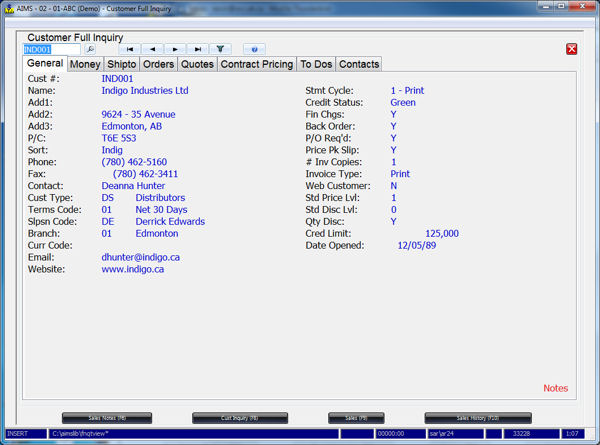
Credit information includes a customer credit limit, a red-yellow-green credit status, date the account was opened, date of last purchase and last payment, the customer’s average days to pay and highest credit balance ever extended.

Direct invoice entry lets you quickly enter invoices and credit memos, which can be disbursed to multiple G/L revenue accounts. (If an AIMS Invoicing module is used, invoices are created there).

Cash receipt processing allows fast and efficient entry of customer payments. This option includes the ability to select payment method (e.g. cheque, cash, charge card or EFT). It also allows storing misunderstood payments as unapplied cash and to adjust invoices – up or down – while creating a corresponding journal entry.

Customer Inquiry lets you collect overdue accounts or approve sales orders on ‘credit hold.’ It displays total due amounts for the customer and outstanding invoice information. You can then view actual invoices and fax them directly from this screen. You can also view and enter credit notes and display customer credit history. Use the filter feature to scroll through only those accounts with balances over 90 days.

All customer transactions are stored with a continuous running balance. This feature aids greatly to answer customer inquiries or reconcile accounts.

Customer statements can be printed for all or a selected group of customers. You can print a detailed or summary Aged Listing by customer or by salesperson and generate finance charges for applicable accounts.

Management reports include five sales reports: a Top/Bottom Customer Analysis, a Customer Sales/Profit Analysis, a Twelve Month Sales Comparison, a Sales/Profit Analysis by salesperson and a Customer YTD Sales by salesperson.

This module integrates with Order Entry, Rental Billing, Service Order and General Ledger.

The Accounts Receivable module does the following:

  • Provides an easy way to maintain customer related files.
  • Lets you efficiently create and post customer invoices (if an AIMS Invoicing module is not being used) and apply payments against customer accounts.
  • Provides an excellent method of collecting money and managing customer credit.
  • Prints, faxes or emails customer statements and provides aged listings
  • Generates finance charges.
  • Tracks and provides summarized sales information.

Information is maintained for customers, customer ship-to locations, salespeople, branches, regions and customer types. Other files store payment terms, sales taxes, customer sales and credit notes, shipping instructions and sales history.

Credit information includes a customer credit limit, a red-yellow-green credit status, date the account was opened, date of last purchase and last payment, the customer’s average days to pay and highest credit balance ever extended.

Direct invoice entry lets you quickly enter invoices and credit memos, which can be disbursed to multiple G/L revenue accounts. (If an AIMS Invoicing module is used, invoices are created there).

Cash receipt processing allows fast and efficient entry of customer payments. This option includes the ability to select payment method (e.g. cheque, cash, charge card or EFT). It also allows storing misunderstood payments as unapplied cash and to adjust invoices – up or down – while creating a corresponding journal entry.

Customer Inquiry lets you collect overdue accounts or approve sales orders on ‘credit hold.’ It displays total due amounts for the customer and outstanding invoice information. You can then view actual invoices and fax them directly from this screen. You can also view and enter credit notes and display customer credit history. Use the filter feature to scroll through only those accounts with balances over 90 days.

All customer transactions are stored with a continuous running balance. This feature aids greatly to answer customer inquiries or reconcile accounts.

Customer statements can be printed for all or a selected group of customers. You can print a detailed or summary Aged Listing by customer or by salesperson and generate finance charges for applicable accounts.

Management reports include five sales reports: a Top/Bottom Customer Analysis, a Customer Sales/Profit Analysis, a Twelve Month Sales Comparison, a Sales/Profit Analysis by salesperson and a Customer YTD Sales by salesperson.

This module integrates with Order Entry, Rental Billing, Service Order and General Ledger.

 
 What's New?
AIMS Handheld

AIMS Handheld allows picking, issuing and inventory counting all through handheld devices.

Pick slips are pulled into the handheld, pickers then scan items and enter quantity picked. This information is then transferred back to the AIMS system for packing slip generation. Handhelds can also issue material to service orders or manufacturing workorders and collect physical count information. Currently only Symbol hardware is supported and development is underway to further enhance this module.

 
AIMS E-Commerce Data Transfer

AIMS E-Commerce data transfer passes data between your AIMS system and an E-Commerce shopping site. Data transferred includes inventory items and pricing from the AIMS server to the E-Commerce server and online orders from the E-Commerce server back to AIMS.

You can also pass customer, ship-to, shipping and sales history data from AIMS to the E-Commerce server.

 
AIMS Data Warehousing

AIMS Data Warehousing pushes your AIMS data to a true SQL database on a routine basis (say nightly). From there you can extract using common reporting tools like Crystal Reports, Excel and Access, or write your own program with C#, Visual Basic or any other SQL language.

Your AIMS data can be pushed to either MS SQL Server or the Firebird database and AIMS Data Warehousing includes pre-defined sales analysis and job costing views along with a great pivot writer. 

 
AIMS Handheld

AIMS Handheld allows picking, issuing and inventory counting all through handheld devices.

Pick slips are pulled into the handheld, pickers then scan items and enter quantity picked. This information is then transferred back to the AIMS system for packing slip generation. Handhelds can also issue material to service orders or manufacturing workorders and collect physical count information. Currently only Symbol hardware is supported and development is underway to further enhance this module.

 
AIMS E-Commerce Data Transfer

AIMS E-Commerce data transfer passes data between your AIMS system and an E-Commerce shopping site. Data transferred includes inventory items and pricing from the AIMS server to the E-Commerce server and online orders from the E-Commerce server back to AIMS.

You can also pass customer, ship-to, shipping and sales history data from AIMS to the E-Commerce server.

 
AIMS Data Warehousing

AIMS Data Warehousing pushes your AIMS data to a true SQL database on a routine basis (say nightly). From there you can extract using common reporting tools like Crystal Reports, Excel and Access, or write your own program with C#, Visual Basic or any other SQL language.

Your AIMS data can be pushed to either MS SQL Server or the Firebird database and AIMS Data Warehousing includes pre-defined sales analysis and job costing views along with a great pivot writer. 


  Whytespace
  Powered by
www.whytespace.ca